

Our Swiss data recovery laboratory
« The precision of a read/write head is comparable to a Boeing 747 flying at 272 km/h less than one centimetre above the ground, able to count every single blade of grass. »
Our laboratory in Ins (Anet)
Our laboratory, located in Ins (Anet), is a purpose-built facility designed for data recovery. Adjacent to our administrative offices, access to the laboratory is strictly controlled: only authorised badge-holders may enter.
The laboratory is divided into specialised zones (soldering, disassembly, data recovery and a dedicated laminar flow bench) to ensure optimal management of each step in the recovery process.
Since 2006, our laboratory has processed over 11,300 media for more than 8,000 clients, individuals and businesses alike. SOS Data Recovery is CyberSafe certified and CyberSafe partner and rated 4.8/5 on Avis Vérifiés (296 reviews).
Our Swiss ISO 5 laminar flow
We operate our own laminar flow bench directly within our laboratory in Ins (Anet). This workstation, dedicated exclusively to delicate operations, is classified ISO 5, the most stringent standard for data recovery environments.
To maintain a perfectly controlled environment, the room is kept under positive pressure and equipped with a ISO 5 certified laminar flow hood. This setup creates an ultra-clean workspace, essential for handling sensitive storage media.
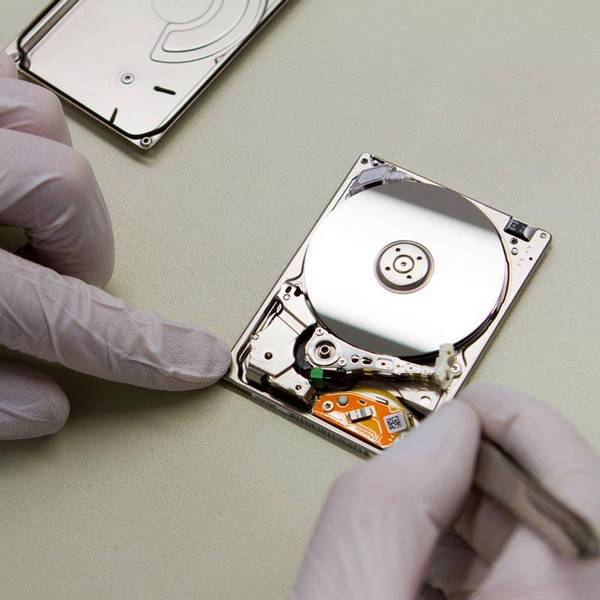
It is in this secure environment that our experts carry out all critical operations: opening hard drives, replacing read/write heads, careful cleaning of platters, and other delicate procedures. This allows us to ensure the best possible conditions to maximise your chances of a successful recovery.
Why work under laminar flow?
The constant evolution of technologies and the miniaturisation of magnetic media require specialised technology to guarantee the feasibility of a recovery.
The surface of a magnetic tape is extremely fragile due to its minimal thickness and coating. Chemically degraded magnetic tapes are highly sensitive to loss of binder and recording material: any careless handling can cause irreversible flaking of these materials.
An ordinary dust particle measures 6,000 nanometres. The read/write head flies just 7 nanometres above the platters. A dust particle is therefore 860 times larger than the fly height: it would cause an instant catastrophic crash.
Without a laminar flow bench, opening a hard drive always results in permanent data destruction.
ISO Class 5 (formerly Class 100) means the air contains a maximum of 100 particles of 0.5 µm per cubic foot. Our workstation is maintained under positive pressure and equipped with ISO 5 certified laminar flow, a level of purity exceeding that used in semiconductor manufacturing.
Discover our laboratory on video
Reports and demonstrations filmed on our premises
Introducing SOS Data Recovery
Discover our team, our laboratory and our unique approach to data recovery.
How a hard drive works
Understand the internal mechanics of a hard drive to better grasp the complexity of data recovery.
Cleaning a hard drive under laminar flow
Demonstration of the platter cleaning protocol under our ISO 5 laminar flow bench.
Frequently asked questions
Our specialists answer the most common questions.
Are your premises secure?
Yes. Access to the laboratory is controlled by individual badge. Only authorized personnel can enter. SOS Data Recovery is CyberSafe certified, a CyberSafe partner and Swiss Label certified, and authorized for the processing of confidential federal data, which guarantees a high level of security and confidentiality.
Can we visit your laboratory?
Yes, visits to our laboratory in Ins (Anet) are possible by appointment. Access to the laboratory is controlled by badge, so the visit is accompanied by a technician. This allows you to see for yourself the safety and cleanliness conditions in which your media will be processed.
Do you work on SSDs and flash memory devices in the lab?
Unlike mechanical hard drives, SSDs and flash memory devices (USB sticks, SD cards) do not require a laminar flow environment because they have no moving parts or magnetic platters. Data recovery relies on microsoldering techniques and direct reading of NAND chips using specialized stations. Our laboratory is equipped for both types of interventions.
How many storage devices have you processed?
Since 2006, we have processed over 11,300 storage devices for more than 8,000 clients. Our experience covers all types of media: hard drives, SSDs, USB sticks, memory cards, RAID servers, NAS devices, and magnetic tapes.
What is an ISO 5 laminar flow?
An ISO 5 laminar flow (formerly Class 100) is a controlled environment in which the air contains a maximum of 100 particles of 0.5 micrometers per cubic foot. This level of purity is essential for handling the internal components of a hard drive without risking contamination.
What is the difference between ISO 5 and other ISO classes?
The ISO classification defines air purity by the maximum number of particles per cubic meter. In ISO 5, the air contains a maximum of 3,520 particles of 0.5 µm/m³. In ISO 7 (a common class in the industry), this figure rises to 352,000 particles — 100 times more. For hard drive data recovery, ISO 5 is the minimum requirement because the read head flies over the platters at only 7 nanometers.
What tools and equipment do you use in your lab?
Our laboratory is equipped with professional-grade specialized tools: PC-3000 stations from ACE Laboratory for low-level media reading, a binocular microscope for microsoldering, a BGA soldering station for NAND memory chips, and an ISO 5 certified laminar flow cabinet for all physical interventions on hard drives. This equipment allows us to handle mechanical hard drives as well as SSDs, phones and magnetic tapes.
Where is your laboratory located?
Our laboratory is located in Ins (Anet), in the canton of Bern, in the heart of Switzerland. It is attached to our administrative offices and accessible by postal delivery or direct deposit.
Why is laminar flow necessary for data recovery?
The read head of a hard drive floats over the platters at only 7 nanometers. An ordinary dust particle measures 6,000 nanometers, or 860 times that distance. Without laminar flow, any opening of a hard drive would cause an immediate head crash and permanent data destruction.
Why not use data recovery software at home?
Data recovery software may be suitable for accidental deletion on a healthy storage device. However, if the drive is making abnormal noises, is no longer detected, or has bad sectors, software will force repeated reads that worsen the physical damage. Each additional attempt further deteriorates the read/write heads and scratches the platters. A professional first performs a bit-by-bit copy in protected mode before any analysis.
Yes. Access to the laboratory is controlled by individual badge. Only authorized personnel can enter. SOS Data Recovery is CyberSafe certified, a CyberSafe partner and Swiss Label certified, and authorized for the processing of confidential federal data, which guarantees a high level of security and confidentiality.
Yes, visits to our laboratory in Ins (Anet) are possible by appointment. Access to the laboratory is controlled by badge, so the visit is accompanied by a technician. This allows you to see for yourself the safety and cleanliness conditions in which your media will be processed.
Unlike mechanical hard drives, SSDs and flash memory devices (USB sticks, SD cards) do not require a laminar flow environment because they have no moving parts or magnetic platters. Data recovery relies on microsoldering techniques and direct reading of NAND chips using specialized stations. Our laboratory is equipped for both types of interventions.
Since 2006, we have processed over 11,300 storage devices for more than 8,000 clients. Our experience covers all types of media: hard drives, SSDs, USB sticks, memory cards, RAID servers, NAS devices, and magnetic tapes.
An ISO 5 laminar flow (formerly Class 100) is a controlled environment in which the air contains a maximum of 100 particles of 0.5 micrometers per cubic foot. This level of purity is essential for handling the internal components of a hard drive without risking contamination.
The ISO classification defines air purity by the maximum number of particles per cubic meter. In ISO 5, the air contains a maximum of 3,520 particles of 0.5 µm/m³. In ISO 7 (a common class in the industry), this figure rises to 352,000 particles — 100 times more. For hard drive data recovery, ISO 5 is the minimum requirement because the read head flies over the platters at only 7 nanometers.
Our laboratory is equipped with professional-grade specialized tools: PC-3000 stations from ACE Laboratory for low-level media reading, a binocular microscope for microsoldering, a BGA soldering station for NAND memory chips, and an ISO 5 certified laminar flow cabinet for all physical interventions on hard drives. This equipment allows us to handle mechanical hard drives as well as SSDs, phones and magnetic tapes.
Our laboratory is located in Ins (Anet), in the canton of Bern, in the heart of Switzerland. It is attached to our administrative offices and accessible by postal delivery or direct deposit.
The read head of a hard drive floats over the platters at only 7 nanometers. An ordinary dust particle measures 6,000 nanometers, or 860 times that distance. Without laminar flow, any opening of a hard drive would cause an immediate head crash and permanent data destruction.
Data recovery software may be suitable for accidental deletion on a healthy storage device. However, if the drive is making abnormal noises, is no longer detected, or has bad sectors, software will force repeated reads that worsen the physical damage. Each additional attempt further deteriorates the read/write heads and scratches the platters. A professional first performs a bit-by-bit copy in protected mode before any analysis.
Why Trust Us?
Your data can be recovered. Act now.
Every hour counts. The more a drive is used after data loss, the harder recovery becomes. Contact us immediately.